Arabic
  English
  Turkish
  Russian
  Chinese
The Portugal D7 visa and the residence permit obtained afterward are designed for individuals who intend to live in Portugal. Therefore, obtaining the D7 residence card is not enough on its own. D7 residence holders must also carefully plan their actual physical presence in Portugal.
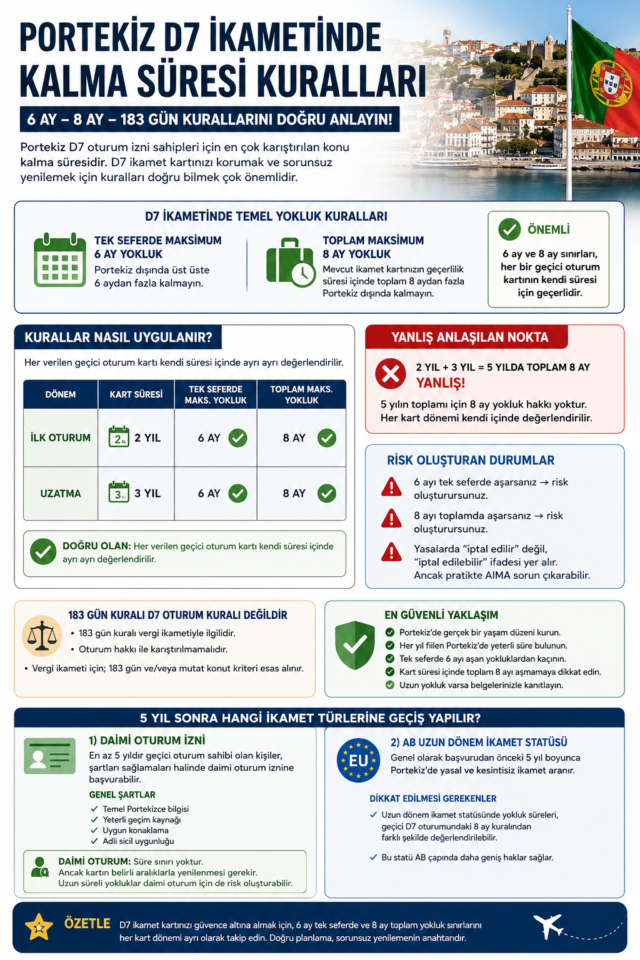
In practice, many applicants hear that “if you stay in Portugal for more than 6 months every year, you meet the requirement.” This may be a useful practical guideline, but it is not the complete legal analysis. For the protection of the D7 residence card, the absence calculation is not based only on the calendar year. It must also be assessed according to the validity period of each temporary residence card.
Why Is Physical Presence Important for D7 Residence Holders?
The D7 residence permit is intended for people who wish to live in Portugal based on retirement income, rental income, dividends, passive income or regular financial resources. The main idea behind this residence type is that the applicant makes Portugal their actual place of residence.
For this reason, AIMA does not only consider the income requirement. It may also assess whether the person has established a genuine residence pattern in Portugal. Address registration, bank account, tax number, healthcare registration, lease agreement, utility bills and entry-exit records may all be relevant.
How Long Is the Temporary Residence Card Valid?
In Portugal, the first temporary residence card is generally valid for سنتان. After that, it is usually renewed for 3-year periods.
| Period | Card Validity | Assessment Period |
| First D7 residence card | سنتان | The validity period of this card |
| First renewal | 3 سنوات | The validity period of the new card |
| Further renewals | 3 سنوات | Each new card is assessed separately |
How Do the 6-Month and 8-Month Rules Apply?
For D7 temporary residence permit holders, there are two important absence limits:
✔️ Not exceeding 6 consecutive months outside Portugal
✔️ Not exceeding 8 months in total outside Portugal during the validity period of the current residence card
The calculation should therefore be made as follows:
| D7 Residence Period | Maximum Consecutive Absence | Total Absence Limit During Card Validity |
| First 2-year card | Should not exceed 6 months | Should not exceed 8 months in total |
| 3-year renewal card | Should not exceed 6 months | Should not exceed 8 months in total |
The key point is this: staying in Portugal for more than 6 months each year is generally a positive indicator. However, it is not the only test. The legal absence limit is not assessed only by calendar year, but also by the validity period of the relevant residence card.
Why Can the “6 Months Each Year” Rule Be Incomplete?
For D7 residence holders, “staying more than 6 months each year” is a commonly used practical guideline. It may help show that the person genuinely intends to live in Portugal. However, this should be assessed together with the total 8-month absence limit.
For example, a person may stay in Portugal for around 6.5 months in each year of the first 2-year D7 residence card. On a yearly basis, this appears to be more than 6 months. However, if the total time spent outside Portugal during that 2-year card period exceeds 8 months, this may create a risk before AIMA.
Therefore, the safest approach is to check both of the following:
| Check | Why It Matters |
| Annual physical presence | Helps show that Portugal is the person’s real place of residence |
| Residence card period calculation | The 6-month consecutive and 8-month total absence limits should not be exceeded |
The 183-Day Rule Is Not the D7 Residence Rule
The 183-day rule is mainly related to tax residence. Whether a person becomes a Portuguese tax resident depends on factors such as the number of days spent in Portugal, availability of a habitual home and the person’s center of life.
Therefore, the 183-day tax rule should not be confused with the 6-month / 8-month absence calculation used for maintaining or renewing the D7 residence card.
| Topic | Relevant Rule |
| Maintaining the D7 residence card | 6 consecutive months / 8 months total absence limit |
| Tax residence | 183 days and/or habitual home criteria |
| Citizenship or long-term residence | Separate residence and continuity requirements |
What Happens After 5 Years of Residence?
After 5 years of legal residence in Portugal, D7 residence holders may have options other than simply renewing their temporary residence permit.
The first option is Portuguese permanent residence. Individuals who have held temporary residence for at least 5 years may apply for permanent residence if they meet the additional requirements. These may include basic Portuguese language knowledge, sufficient means of subsistence, accommodation and a clean criminal record.
Permanent residence itself is not limited in duration, although the residence card must be renewed periodically. The absence rules for permanent residence are different from those for temporary residence. Long absences from Portugal without a justified reason may still create a risk.
The second option is EU long-term resident status. This status generally requires 5 years of legal and continuous residence in Portugal before the application. The absence rules for EU long-term residence may be assessed differently from the 8-month rule applicable to a temporary D7 residence card.
خاتمة
For Portugal D7 residence holders, the correct approach is not simply to say, “I stayed in Portugal for more than 6 months each year.” This may be an important practical guideline, but it is not enough on its own.
The safest approach for D7 residence holders is:
✔️ Establishing a genuine residence pattern in Portugal
✔️ Spending sufficient time in Portugal each year
✔️ Avoiding absences of more than 6 consecutive months
✔️ Tracking the total 8-month absence limit during the validity period of the current residence card
✔️ Keeping documents to justify long absences if necessary
✔️ Assessing permanent residence or EU long-term residence options after 5 years
The D7 residence card is not merely a document. It is a status that reflects the continuing intention to live in Portugal. Therefore, physical presence, travel planning and renewal strategy should be managed carefully from the beginning.